
FSU Sport Psychology Lab uses Student Technology Fee to study brain activity
By Parker Ladle
What happens in the brain before a person loses balance, makes a split-second decision or performs under pressure? Florida State University researchers are using new technology to find out.
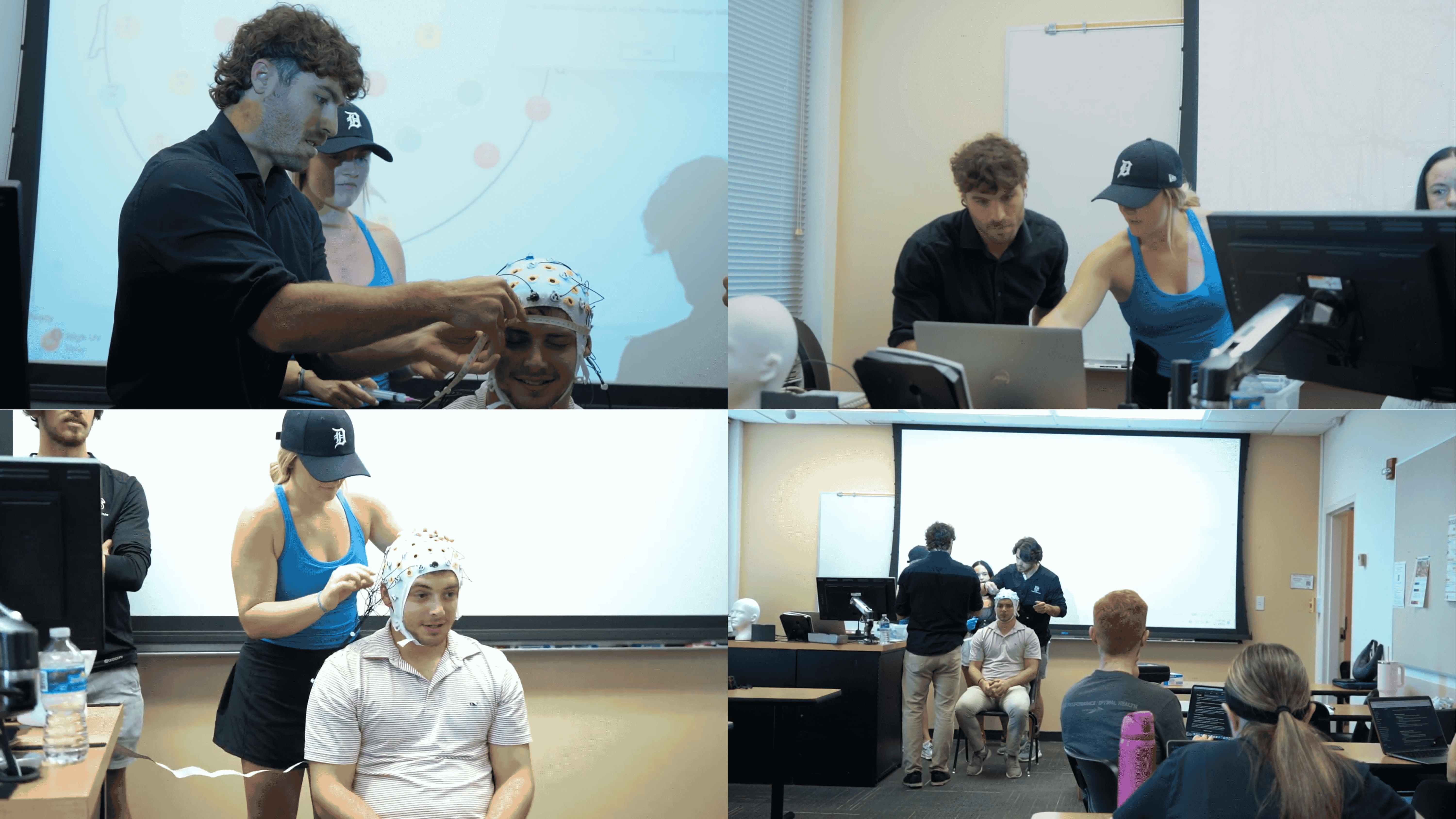
Funding from the Student Technology Fee allowed the Brain, Learning, Attention, and Performance (BLAP) Lab to acquire a research-grade electroencephalogram (EEG) system. Led by Brady DeCouto, the lab uses this EEG system to advance research on human performance while giving students rare, hands-on experience with neuroscience tools in a sport psychology setting.
"This technology has enabled us to look at some research questions that we weren't able to look at before,” DeCouto said. "It's one thing to measure behaviors, but it's another thing to measure what is contributing to the behavior. It's a window into the mind."
The lab, housed within FSU's Sport Psychology Lab uses the EEG system to study brain activity associated with anxiety and balance recovery. Specifically, DeCouto and his team are examining how individuals respond neurologically before experiencing a simulated fall. These findings could help scientists better understand how conditions like anxiety disorders or concussions affect movement, balance and performance.
DeCouto also incorporates the EEG system into his coursework, demonstrating neuroscience concepts in real time and letting students use the technology for their own research interests. By collecting and analyzing neural data themselves, students gain hands-on experience with tools that are often available only in advanced research settings.
“The information I've been able to learn as a student, but also as an employee working with this technology, has really been a privilege,” said Eli Zemach, a graduate research assistant. “It's helped educate the applied work and consulting that I do with my clients.”
DeCouto noted that few sport psychology labs across the country have access to equipment of this caliber.
“This technology is really cutting edge,” he said. “The students have the opportunity to use and learn from these technologies that go beyond just the behavioral level or the intervention level. We're looking at psychological processes, physiological processes and how they relate to behaviors and interventions.”
As sport psychology research continues to advance, the Student Technology Fee investment is helping position FSU at the forefront of the field. By providing access to advanced research tools, the funding is expanding opportunities for discovery while preparing students with the skills and experience to advance the future of sport psychology research and practice.
For more information on how the Student Technology Fee supports innovation at FSU, visit its.fsu.edu/stf.