
RCC Spotlight: Leo Liu, Ph.D.
In the United States, heart disease and strokes are some of the leading causes of death. Over 900,000 people die from heart disease each year, meaning that roughly one-third of deaths in the United States result from heart disease. It is estimated that around 805,000 Americans will have a heart attack every year, and up to 800,000 experience a stroke. Strokes take over 166,000 lives annually, meaning they are typically ranked the fourth or fifth leading cause of death. These numbers are quite alarming, and in the face of these public health crises, some may wonder what scientific interventions are being developed to address them.
Leo Liu, an assistant professor in the Department of Chemical and Biomedical Engineering at the FAMU-FSU College of Engineering, studies blood flow and blood clotting to understand the physical mechanisms underlying them and how they contribute to ailments such as heart disease. His team relies on Florida State University's Research Computing Center (RCC) to model processes that are too small and too fast to observe directly.
Blood, although liquid, is different from other fluids like water, Liu said. It is a "living fluid" packed with cells and proteins. Red blood cells alone make up about 40% of blood's volume. Many of the diseases Liu's team studies are tied to those components, so the team models how cells and proteins deform, move and interact as blood flows.
“In order to understand how the cells and proteins in the blood flow build up into a deadly blood clot, we have to model them... the deformation, the dynamics, the motion, and the interactions of all those ingredients,” Liu said. "It's a flow problem, it's a biological problem, it's a mechanics problem and it's a chemical problem ... it’s a very interdisciplinary topic.”
The work is also multiscale, meaning that what happens at larger scales depends on what happens at very small scales, both spatially and temporally, and the vessels and cells being studied vary widely in size. Blood vessels range from the aorta, which is measured in tens of millimeters, to capillaries about 10 microns wide. Red blood cells are disc-shaped and about 8 microns in diameter. In the gaps between red blood cells are proteins such as von Willebrand factor (VWF), a chainlike molecule that is about 100 nanometers thick but can extend to a few microns.
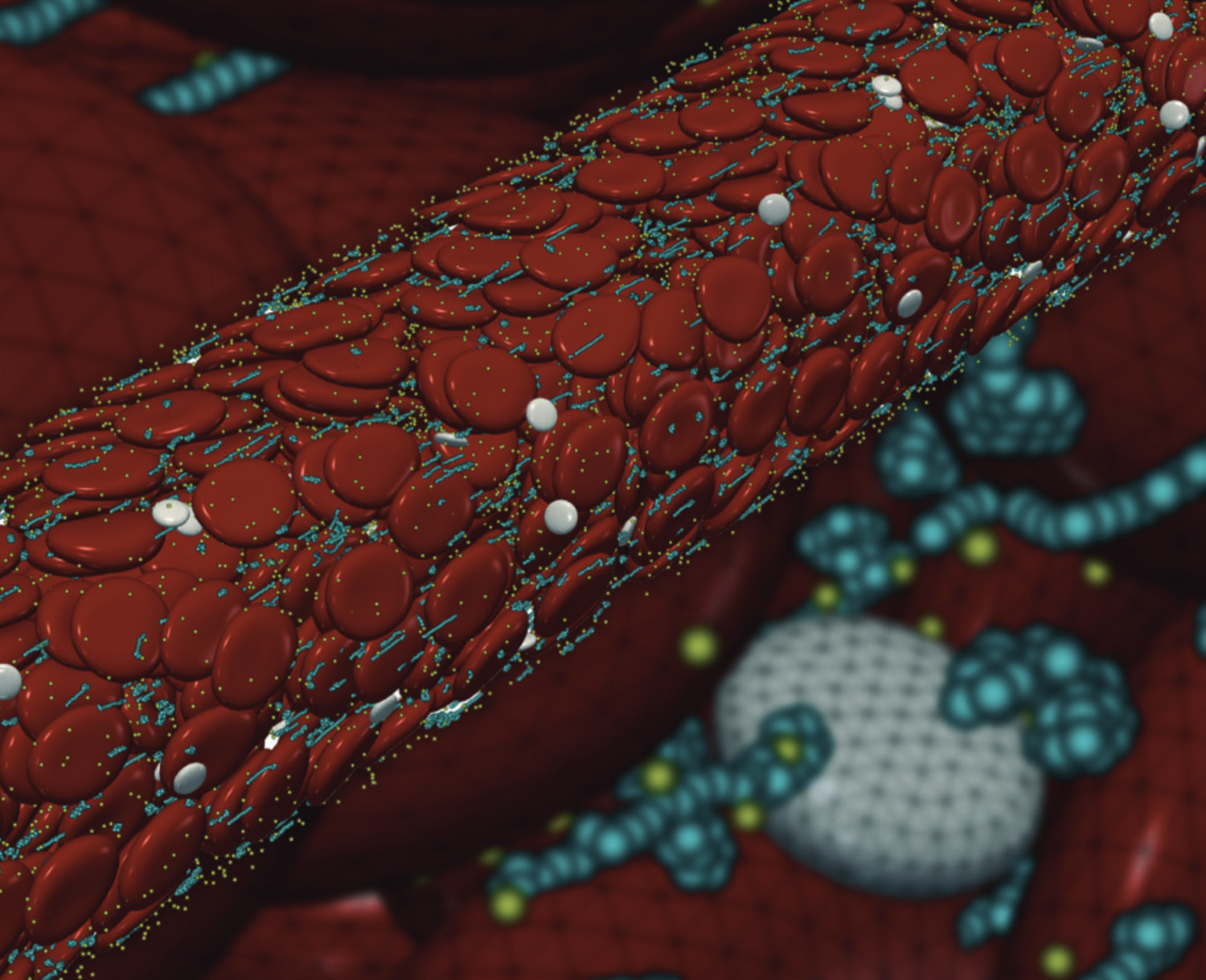
Time scales vary just as widely. Interactions between cells and proteins must be captured in nanoseconds, but a blood clot takes at least a few minutes to form, a gap of more than 10 orders of magnitude. Bridging that gap requires models built specifically for multiscale problems, as well as parallel processing across hundreds of thousands of compute cores.
"It's very computationally expensive to model," Liu said. "So, we have to rely on supercomputing to do that."
That computing power recently led Dr. Liu and his team to a new discovery about VWF, a protein central to the formation of clots that block blood vessels and cause heart attacks and strokes. Liu's simulations found that the cells surrounding VWF play an important mechanical role in activating the protein, which must be activated before it can bind to other cells and form a clot. The interaction between cells and the protein acts as a switch that controls whether VWF activates. Conditions such as stenosis, a chronic narrowing of the blood vessels, tend to enhance that process. Liu's team is still publishing the results.
The finding could not have been made without powerful supercomputing capabilities, Liu said. No microscope can capture interactions at such small scales and nanosecond speeds, especially when they must be observed many times. After the simulations revealed the mechanism, the team ran experiments at a measurable scale to validate it, and the results agreed with the computational predictions.
"Without supercomputing, you couldn't really see it from the experiments," Liu said.
Understanding the mechanism could help researchers design better drugs and medical devices to prevent heart attacks and strokes, he said.
Looking ahead, Liu sees artificial intelligence making computational tools more widely available. His research involves creating large, complex code that used to take many years of experience to develop, but he says AI is shortening that process. Liu said he expects computational biology tools to have their own "ChatGPT moment," making it easier for researchers to reach potentially lifesaving discoveries.
"We are working on it, and I believe that's coming," Liu said. "I'm very hopeful.”